Free
Forever. No card.
$0
- 5 plants, 1 bed (4×8)
- ROI tracker
- Share card
- CSV export
The grocery math
Cherry tomatoes at the store: $5.44/lb. A healthy plant puts out 8 pounds a season. Do the math on a full 4×8 bed and you are looking at $300 to $500 of produce you already grew and never priced.
Harven prices every harvest against real retail data (BLS + USDA) so you know, down to the dollar, what your bed is actually worth.
A typical 4×8 bed, one season
Grocery equivalent value of 46 pounds of produce from one well planted 4×8 bed. Priced against BLS retail averages, not a hype number.
Based on 2 cherry tomatoes, 1 roma, 2 bell peppers, basil, lettuce, radish, carrot, green bean. Yields bounded by peer reviewed ceiling (Algert 2016, Dorr 2023).
How Harven works
Pick from 20 free crops (80 in Pro) in a 4×8 grid. We warn on companion clashes using peer reviewed pairs, with the paper right there in the app.
Tap the plant, enter pounds picked. Takes five seconds. Works offline so a muddy garden has no excuse.
Every pound gets priced against live BLS retail data. Hit $50, $100, $250, $500 and your ROI card fires. Yours to share.

Who it’s for
If you see yourself here, you’re going to love this.

You just built your first raised bed and have no clue if it’s worth the effort. Harven tells you, by the pound.

Food prices are nuts. You grow to save money. Harven proves it with real BLS prices, not vibes.

You already grow. You want history, exports, and receipts. Harven gives you season by season numbers you can actually show your spouse.
The data on home gardens
Pulled from peer reviewed studies, not blog folklore. Every number links to its source.
of produce from a $238 home garden. The cleanest ROI benchmark in the literature.
Journal of Extension, 2014 ↗of first year gardeners quit before harvest. Harven is built to keep you in that other two thirds.
JArDinS + CAPS RCTs ↗cups of vegetables per day. Gardeners eat roughly double what a non gardener does.
Algert, California Agriculture, 2016 ↗less fruit and veg waste than the average household. People don’t throw away food they grew.
Gulyas & Edmondson, 2023 ↗of gardening lowers cortisol more than reading indoors. The garden is medicine with a side of salad.
Van Den Berg & Custers, 2011 ↗more yield captured when you log harvests instead of guessing from memory. This is why we track.
Kilic, World Bank, 2018 ↗Four more stats power the in app coaching, share cards, and weekly threads. We show our work.
Where our numbers come from
Every number you see comes from real government data and real science studies. Here’s where.
Our data comes from:
USDAGovernment grocery prices, updated monthly by the U.S. Bureau of Labor Statistics. The same agency that tracks inflation.
Farm and market price reports from the U.S. Department of Agriculture.
Planting calendars from University of California’s public farming research.
17 science studies on which plants help or hurt each other when grown side by side. Every study is linked inside the app.
14 natural pest fixes, each backed by a published study. Not a Pinterest tip.
Two studies that measured how much food a home garden actually produces. We use their numbers so our savings math can’t be exaggerated.

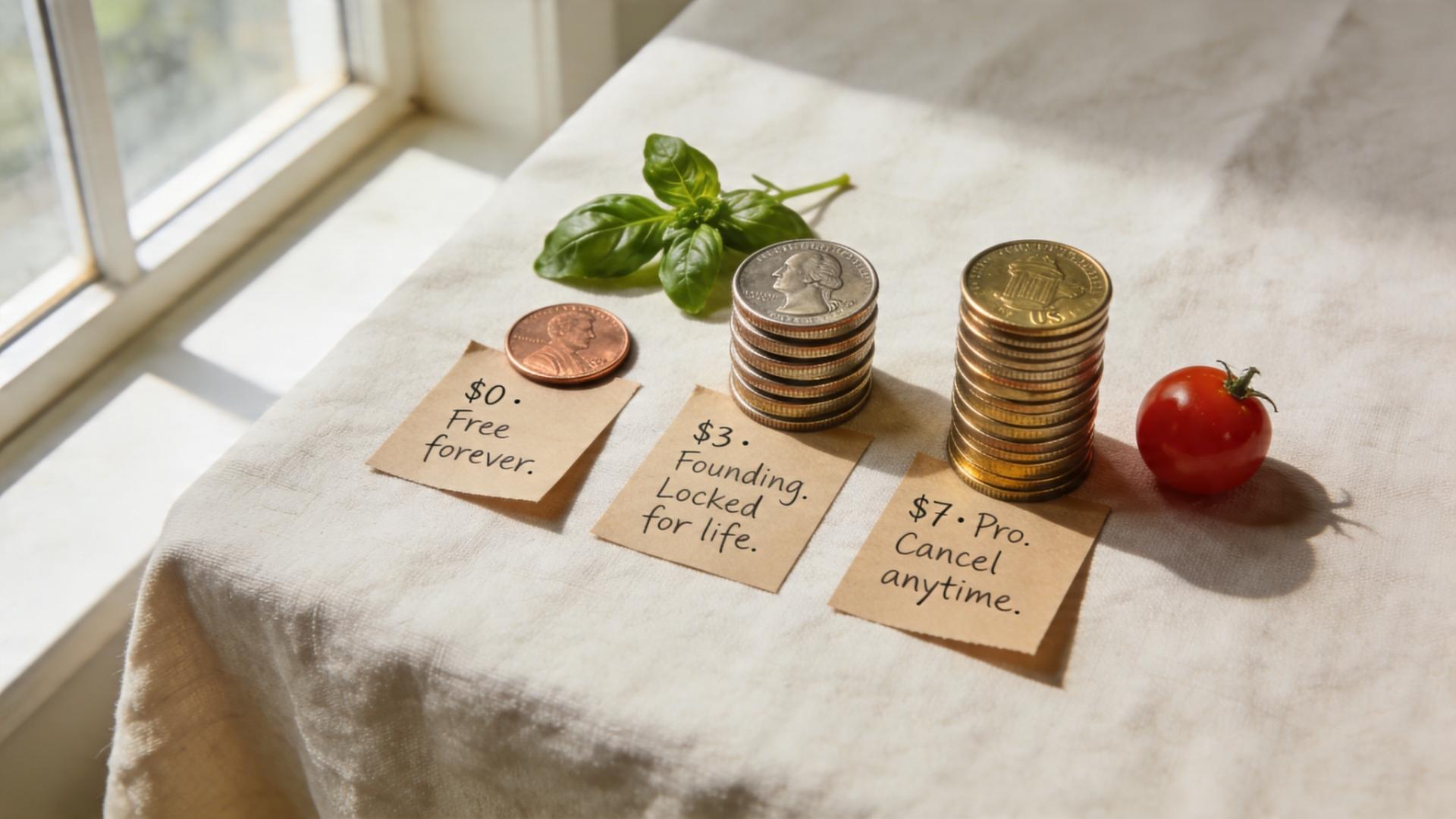
Pricing
Monthly. Cancel anytime. No annual traps.
Founding pricing ends in
Forever. No card.
$0
Locked at this price forever.
$7/mo
$3 /mo
Save $48 a year
Cancel anytime.
$7 /mo
No. Free tier is forever. If you upgrade later, it's monthly with a one click cancel.
Yes. Harven is offline first. Log harvests underground, in the back of the yard, on a plane. It syncs when you reconnect.
Prices from BLS CPI retail averages and USDA market reports. Yields from peer reviewed home garden trials, with every source linked inside the app. Planting calendars from UC Cooperative Extension. Nothing invented.
Your data stays. You keep your ROI history and 5 plants on the free tier.
You do. Everything lives on your device first. Export your whole garden to CSV in one tap. If you ever walk away, take it all with you.
Yes. Every US zip code maps to a USDA hardiness zone (3a through 11b). Planting calendars adjust automatically so you plant at the right week, not the generic one.
80 plus crops at launch. Tomatoes, peppers, squash, greens, roots, brassicas, alliums, beans, herbs, melons, potatoes, berries, and a few fruit trees. Staples first, curiosities later.